Showing posts with label Battles. Show all posts

Wednesday, October 26, 2016

Second Battle of St Albans – 17 February 1461

Detail from Graham Turner‘s Battle of st Albans.Fought on the 22nd May 1455, this was the first battle of what would become known as the Wars of the Roses.

 
Kingmaker, Earl of Warwick, still only thirty-three, had not waited for his young ally before leaving London. With the queen far in the north, he mustered the men of Kent to add to his own men and the Burgundian mercenaries he had acquired. Many of the Burgundians arrived carrying early handguns that fired lead shot, something never before seen in England. The earl reached St Albans when shocking news arrived of just how close the army from the north now was. There was little choice but to set up around St Albans and prepare the town for its second dose of war. Warwick’s thirty-year-old brother John was with him and they set up wooden palisades to protect the town and laid caltrops, nets dotted with spikes designed to break up cavalry charges by injuring the horses.


Tension north of London must have reached melting point. The queen’s army had descended south, with Scotsmen in tow who had been promised their pay in whatever they could pillage as they passed. Warwick was moving north to meet them. Both sides had scores to settle and folks in every part must have feared for their property and their lives. Gregory’s Chronicle tells of a butcher who led a band of men in the king’s name to a fight at Dunstable, where they encountered a detachment of the Scots, perhaps seeking out their booty. The butcher led the ragtag band of raw recruits onto the field but they were slaughtered, 800 men perishing due to the ‘simple guidance’ of the butcher. Gregory laments that soon after the fighting, either for shame at his dismal performance or for the loss of all of his goods to the Scots, the butcher hanged himself.


The tide seemed to turn in Warwick’s favour as the queen’s army approached St Albans the day after the butcher’s failure at Dunstable. By then, 17 February 1461, many of the Scots had fled, either growing concerned by the distance between them and their homes or else already so heavily laden with their pay that they saw no further need to fight. Gregory estimates that less than 5,000 men remained in the queen’s force. That was still an impressive number. Campaigning in the winter was all but unheard of and it was almost two months into this round of brutal exchanging of blows. All of her army wore the livery of her son the Prince of Wales, bands of black and crimson with an ostrich feather badge. It was clear that she was calling men to her in the name of the dispossessed heir of the House of Lancaster rather than his father.


Andrew Trollope was to play a prominent role in the coming fighting once more. Having left the Yorkist cause at Ludlow and possibly contributed to tricking the Duke of York out of Sandal Castle at Wakefield, he led a lightning strike into the town of St Albans, catching those within the city unawares and driving them away. This allowed him to catch John Neville’s large force, set up outside the town, in a pincer movement with the rest of the queen’s army. Around 2,500 men died in the intense fighting. In an early blow, a large contingent of Kentish men took up their weapons and walked away from the field. Their leader, a man named Lovelace, had been captured at Wakefield but released upon giving his oath never to take up arms against the queen and her prince again. He and his men deserted Warwick to maintain his honour.


Either in the sudden confusion or because of the cold, damp weather, Warwick’s expensive artillery failed. Gregory recounts that there were not only the new fangled handguns, firing either lead shot or unusual double-flighted arrows, but also wildfire, the weapon of terror deployed against London by Lord Scales. All failed to be deployed, some backfiring in the hurry to react, guns blowing up in the faces of their operators and wildfire turning viciously back upon those who would use it. Although Warwick probably had far superior numbers the tactics of the queen’s army maximised the advantages of the tight streets of the town and the element of surprise.


Warwick and the other lords fled. King Henry had sat beneath a tree as the battle had raged, singing and laughing, completely oblivious to the carnage about him and the stakes involved in the fighting. Lord Bonville and Sir Thomas Kyriell stayed behind to protect the king when all others fled, passing up their own opportunity to make good their escape. Henry assured them that they would not be harmed while they were with him for the protection and loyalty they showed. Margaret had the men seized and with the encouragement of the Duke of Exeter and the Earl of Devonshire placed them on trial for treason the next day. Their judge and jury was the seven-year-old Prince Edward, who duly pronounced a sentence of death upon the two men for their crimes. William Bonville was nearly seventy years of age and Kyriell was only a few years younger. Both must have been bewildered at the sentence passed by a little boy, doubtless at the instigation of his mother and two lords with land interests in Bonville’s homeland in the West Country. Once more, land disputes played a pivotal role in the vicious feuding below the surface of the Wars of the Roses. Bonville had turned to the Yorkist cause at Northampton and may have been responsible for guarding Henry there after his capture, giving Margaret a thin motive for revenge too.


King Henry was reunited with his wife and son. On the battlefield, Henry knighted his young son and then watched on as the boy knighted several others in turn. The first was Andrew Trollope, stalwart of the king, queen and prince’s cause. Trollope had been wounded trying to cross the net of caltrops. With his foot painfully pierced he had not been able to move any further. Gregory reports that Trollope, with a modesty that was probably false, knelt before Prince Edward and told him ‘My lord, I have not deserved it for I slew but fifteen men, for I stood still in one place and they came unto me’. Sir Andrew’s star was in the ascendant. His service had turned the tide of the struggles more than once in favour of Queen Margaret’s party and his rewards were coming.


No party appeared capable of the act of clemency or kindness that might soothe the worst of the fighting. Too many now had personal vendettas to follow, land and money to gain from seeing rivals destroyed and their own fortunes too closely aligned with one party or the other to give an inch. There was no mercy in England now. There was one odd exception to this rule. Warwick’s brother John was captured for a second time, yet just as he had after Blore Heath he escaped punishment once more to be inexplicably released. In light of the fates of Bonville and Kyriell, the leniency shown to John Neville, who had led the vanguard of Warwick’s army in the fields outside St Albans, defies belief.


The queen’s unexpected victory against the previously undefeatable Earl of Warwick, who headed west to meet his cousin Edward, sent London into panic. The city was terrified that Margaret, who had no love for the capital, would exact a cruel price for the city’s support of Warwick. She had promised the remaining Scots soldiers payment in loot and London was the main prize. The city officials fell into a frenzy. Margaret sent the Duchess of Buckingham, the widow of the old duke, to negotiate and promise that no harm would come to the city, its inhabitants or their property. Dubiously, the mayor and aldermen wrote to the queen assuring her of their loyalty and good will. When soldiers were seen approaching the gates shortly after, possibly led by the Duke of Somerset, the citizens attacked them, killing many and driving the rest away. The mayor and aldermen panicked even more, gathering food and money in carts to send to supply the queen’s army in the hopes of appeasing her. When the citizenry learned of the plan they seized the keys to the gates, locked them tight and divided the carts of provisions among themselves.


In an uncharacteristic act of acquiescence Margaret decided to take her army back northwards. Fear of the Scots would never work for her and those that had already left were pillaging their way back home, taking property, money and even the beasts that worked men’s lands, leaving them with nothing. Her heartlands were north too, in the Midlands, and maintaining a siege of London with a dwindling, cold, tired army who just wanted their home and hearth was hardly practical.


Friday, August 5, 2016

Armchair General Towton Recreation

Armchair General Towton Recreation

The last time Seimon asked me to help out with a photo shoot I ended up with 12 stone of American G.I. plus his parachute gear suspended from my waist... I couldn't walk properly for days. I should have realised that Seimon's photo shoots are never quite a straightforward "stand there and smile," type affair.

The Guns of the Battle of Bosworth, 1485


The Guns of the Battle of Bosworth, 1485

EDITOR'S NOTE: The November 2012 issue of Armchair General magazine features ACG Board Member and internationally-renowned forensic archaeologist Douglas D. Scott's article "Battlefield Detective: The Case of the Small Lead Ball." The diminutive (less than 30mm) lead ball - fired by a small cannon during the 1485 Battle of Bosworth - helped battlefield detectives, at long last, discover the true location of one of history's most famed battles.

Wednesday, August 12, 2015

Stoke – the last battle


In recounting how Lady Margaret had wept at her son’s coronation, Fisher makes it clear that she did so from foreboding rather than joy. Many people in the north and in Wales, who had done very well under Richard, disliked the new regime. So did the English-speaking Irish of the Pale, traditionally loyal to the House of York. In the Low Countries the late King’s sister, Margaret of York – ‘mine old lady of Burgundy’ – was ready to welcome any of his former supporters who were in need of a refuge or who required a base from which to launch an invasion of England.

During April 1486 Sir Humphrey Stafford tried to raise his native Worcestershire against Henry VII while Lord Lovell, once King Richard’s Lord Chamberlain (‘Lovell our Dog’), attempted a rebellion in the North Riding. However, their candidate for the throne, the Earl of Warwick – Clarence’s son – was a prisoner in the hands of Margaret Beaufort, and they failed to win any significant support. Sir Humphrey Stafford was dragged out of sanctuary and beheaded, though Lovell got away.

On 19 May Lady Oxford wrote to her husband’s old ally, John Paston, in his capacity as Sheriff of Norfolk and Suffolk.

I am credibly informed that Francis, late Lord Lovell is now of late resorted to the Isle of Ely to the intent, by all likelihood, to get him shipping and passage in your coasts, or else to resort again to sanctuary if he may. I therefore heartily desire . . . that ye in all goodly haste endeavour yourself that such watch or other means be used and had in the ports and creeks . . . to the taking of the same late Lord Lovell. And what pleasure ye may do to the King’s Grace in this matter I am sure is not to you unknown.

The Countess had good reason to dislike Yorkists, but despite all her precautions Lovell succeeded in escaping to Burgundy.

Early in the spring of 1487 a priest brought an Oxford organ-builder’s son called Lambert Simnel to Dublin, pretending that the boy was the Earl of Warwick. Lambert was immediately hailed as king by the Irish Chancellor, Sir Thomas FitzGerald of Lackagh, a brother of the Earl of Kildare who was the most powerful man in Ireland. The FitzGeralds quickly contacted the Yorkist dissidents who had taken refuge in Flanders. Their leaders were Lord Lovell and John de la Pole, Earl of Lincoln, whom Richard III had recognized as his heir presumptive. The Yorkists and the FitzGeralds agreed that they should invade England together as soon as possible. They were warmly encouraged by Margaret of York who, according to Vergil, ‘pursued Henry [VII] with insatiable hatred and with fiery wrath never desisted from every scheme which might harm him’. She gave them money and troops.

On Whit Sunday 1487 (24 May) Lambert, after having been recognized formally as its sovereign by the Irish Parliament, was crowned and anointed as ‘King Edward VI’ by the Archbishop of Dublin in Christchurch Cathedral. No proper crown was available so a diadem was borrowed from a statue of the Virgin. Another important Irish prelate, the Dominican Bishop of Meath, preached the coronation sermon.

Always on the alert, despite conflicting information from his many spies, Henry VII had already begun to suspect that a Yorkist invasion was imminent. His first concern was for the safety of the Queen and his mother. ‘We pray you that, giving your attendance upon our said dearest wife and lady mother, ye come with them to us’, he wrote urgently to the Queen’s chamberlain, the Earl of Ormonde.7 On 13 May the King summoned Lord Oxford to Kenilworth Castle, to discuss how they should prepare for the looming campaign.

By that time Lord Lovell and the Earl of Lincoln had landed at Dublin with a band of Yorkist diehards. They were accompanied by 2,000 Swiss and German mercenaries under the renowned Colonel Martin Schwarz (once an Augsburg cobbler), who had been hired by ‘mine old lady of Burgundy’. Reinforced by the FitzGeralds, they sailed across to Lancashire, landing on the Furness peninsula, not far from Lancaster, on 4 June.

The Yorkist strategy seems to have been to march as far south as possible after crossing the Pennines before giving battle. Although the citizens of York failed to respond to a letter sent to them from Masham by ‘Edward VI’, and beat off an attempt to occupy their city by the two Lord Scropes, the Earl of Lincoln was surprisingly confident. Probably he was counting not only on the excellent quality of his troops but on the intervention of secret allies as at Bosworth once the two armies were engaged. Nothing else can explain his extraordinary optimism. Vergil was convinced that Lincoln (who may have planted Lambert Simnel on the Irish) was planning to seize the throne for himself as soon as Henry VII had been defeated. But Lambert was far too unconvincing a pretender to win much support, and no more than a score of knights and squires joined the Yorkists. Moreover, as a commander Lincoln was scarcely in the same league as the Earl of Oxford.

Christopher Urswick brought King Henry the news that the Yorkist expedition had landed in Lancashire. Although no overall figures are available, it is clear that the King had sufficient support from his magnates to be able to assemble an impressively large army. Vergil names more than sixty gentlemen of substance who served in it, and afterwards an unprecedented number of knights were created. It included 6,000 men provided by the Stanleys alone, the King’s stepfather sending every retainer and well-wisher he could muster under his son, Lord Strange. Among the other peers who rallied to the King was William Hastings’ son Edward, who had been restored to his father’s barony and estates. Archbishop Morton, accompanied by his nephew, the Bishop of Worcester, brought a substantial force of retainers and of tenants from his wide estates. So did the Courtenay Bishop of Winchester.

The Archbishop of Canterbury and the Bishops of Worcester and Winchester were the first prelates to bring troops to a battle during the Wars of the Roses. However, it will be remembered that Dr Morton was no stranger to battlefields and might even be described as a veteran campaigner. He had been present at the second St Albans and Towton, had been besieged in the grim Northumbrian sieges of the 1460s, had been taken prisoner at Tewkesbury, and had been amid the collapse of the Duke of Buckingham’s disastrous rebellion four years before. Although nearly seventy by now, John Morton was leaving nothing to chance – he did not underestimate the danger from the Yorkists. He rode with his troops as far as Loughborough in Leicestershire before handing over command to his nephew, Robert. They were going to fight in the front ranks, in Lord Oxford’s contingent.

As Professor Ross stresses, the battle about to take place could have gone either way. Treachery might have lost it for Henry VII just as treachery had lost Bosworth for Richard III. Obviously the King suspected some sort of plot. There can be no other explanation for his ordering Oxford to place the Marquess of Dorset under arrest before he could join the royal army.

Despite being outnumbered, Lord Lincoln, the enemy commander, was only too eager to give battle. At 9 a.m. on 16 June the Yorkists, about 9,000 strong, engaged the royal army which was in three columns drawn up in echelon (one behind the other) outside the village of Stoke, a few miles from Newark. Schwarz’s landsknechts were obviously professionals to their fingertips, while Lincoln’s followers and the Irish gentlemen were well armed. However, the barefooted, saffron-shirted Irish kern who formed the bulk of their force were a different matter, being without any form of armour and equipped merely with axes, long knives and javelins.

The Earl of Oxford commanded the King’s vanguard or front column, which alone engaged the enemy. Clearly Lincoln’s men fought with great courage, but the unarmoured Irish suffered appalling casualties, one report saying that 4,000 of them were killed. Eventually Oxford won the day with a final determined charge. Schwarz’s men fought to the death by the side of their colonel. Among the many other casualties were Lincoln and Sir Thomas FitzGerald. Lord Lovell – King Richard’s old friend – was last seen swimming his horse across the River Trent.

The Yorkist diehards would never again dare to challenge the Tudors in armed confrontation, and they went underground. Yet their cause was far from dead. Nor had Henry’s victory been a foregone conclusion. Northern noblemen had joined the rebellion, such as the two Lord Scropes, while the Bishop of St Asaph, Dr Richard Redmayne, was suspected of involvement. Significantly, when a mistaken rumour that Henry had been defeated reached London, riots broke out in favour of the Earl of Warwick. A City chronicler tells of ‘false Englishmen . . . which untrue persons said that the king was lost and the field was lost’. Yorkists emerged from their sanctuaries to attack royal officials, shouting that Warwick was King. If the Earl had been old enough and of the same calibre as his uncles, he could have escaped from the Tower of London, and there might easily have been another Yorkist restoration.


Wednesday, March 18, 2015

BATTLE OF EDGECOTE, (1469)


Looking north east across the plain, identified by Haigh as the battlefield, towards Trafford Bridge Farm.

Fought on 26 July 1469 near Banbury in Oxfordshire, the Battle of Edgecote allowed Richard NEVILLE, earl of Warwick, to seize temporary control of EDWARD IV and thereby initiate a new phase of the WARS OF THE ROSES.

In the spring of 1469, Warwick, angered by the growing wealth and political influence of Edward IV's in-laws, the WOODVILLE FAMILY, and certain of the king's favorites, such as William HERBERT, earl of Pembroke, forged an alliance with George PLANTAGENET, duke of Clarence, Edward's equally disgruntled younger brother. The pact, which was sealed on 11 July with Clarence's unauthorized marriage to Warwick's daughter, Isabel NEVILLE, aimed at separating the offending courtiers from the king and making Warwick and Clarence the premier peers of the realm. The allies issued a manifesto calling for loyal Englishmen to support them in reforming Edward's corrupt government and expressed support for an ongoing northern rebellion led by someone calling himself Robin of Redesdale, who had issued a similar call for reform in mid-June. In reality, the ROBIN OF REDESDALE REBELLION was directed by Warwick, and probably led by Sir William Conyers, a Neville retainer. By drawing Edward into the north, the Redesdale uprising sought to give Warwick time to secure LONDON and raise an army.

When Edward marched north in June to confront the Redesdale rebels, he was unaware of their connection to Warwick and Clarence. By mid-July, he was in Nottingham awaiting the arrival of forces from WALES under the command of Pembroke and Humphrey STAFFORD, earl of Devon. Although he was by this time probably aware of Warwick's activities, the king made no move, and the Redesdale rebels bypassed Nottingham to hasten their meeting with Warwick, who was marching north from London. On the evening of 25 July, Pembroke and Devon argued over billeting arrangements. As a result of the quarrel, Devon withdrew toward Banbury with the ARCHERS, leaving Herbert with only the Welsh footmen. Shortly afterward, Pembroke encountered the Redesdale rebels, who attacked him vigorously the next morning. Although Pembroke's men offered fierce resistance, they were hampered by lack of archers and forced to retreat with heavy losses. When advance elements of Warwick's army arrived later in the day, a second rebel attack broke Pembroke's force before Devon could engage his men.

With Conyers and many others dead on the field, Pembroke and his brother were taken prisoner and executed the next day at Northampton in Warwick's presence. Devon was killed some weeks later in Somerset and Richard WOODVILLE, Earl Rivers, and his son Sir John Woodville, whom the king had sent away from him for their safety, were captured and executed at Coventry in August on Warwick's orders. Hearing of the disaster at Edgecote, Edward, now deserted by most of his RETAINERS, was on the road to Northampton when he was taken into Warwick's "protection" by the earl's brother, Archbishop George NEVILLE. For the moment, the king and the royal government were in the hands of Warwick and Clarence. Although Edward soon regained his freedom, he lacked the political strength to proceed against the earl and the duke, who extorted a royal pardon and remained free to resume their rebellion in 1470.

Further Reading: Haigh, Philip A., The Military Campaigns of the Wars of the Roses (Stroud, Gloucestershire, UK: Sutton Publishing, 1995).

BATTLE OF STOKE, (1487)

Considered the last major battle of the WARS OFTHE ROSES, the Battle of Stoke, fought on 16 June 1487, ended the first significant attempt to overthrow HENRY VII and restore the house of YORK.
The failure of the 1486 LOVELL-STAFFORD UPRISING resulted in large part from the lack of a Yorkist candidate for the throne to rally support. This deficiency was remedied in 1487, when a priest named Richard (or William) Simonds arrived in IRELAND with a boy Simonds claimed was Edward PLANTAGENET, earl of Warwick, the nephew of EDWARD IV. Although the child was in reality Lambert SIMNEL, the son of an Oxford tradesman, he was apparently attractive and intelligent and well coached by Simonds to play the part of a Yorkist prince. Gerald FITZGERALD, earl of Kildare, the Irish lord deputy, immediately accepted Simnel as Warwick, not, probably, out of genuine belief, but in the hope that a Yorkist regime restored with Irish assistance would grant Ireland greater autonomy. Having won a base in Ireland, the Simnel imposture gained further support in BUR GUNDY, where Duchess MARGARET OF YORK, the real Warwick's aunt, and such prominent Yorkist exiles as Francis LOVELL, Lord Lovell, and John de la POLE, earl of Lincoln, another nephew of Edward IV, joined the movement. Lincoln and Lovell came to Dublin for the 24 May coronation of Simnel as "Edward VI," bringing with them men and money supplied by Margaret. Although the ultimate intent of the Yorkist leaders was probably to enthrone Lincoln, they were willing to use Simnel as a figurehead to generate support for a Yorkist restoration.

In LONDON, Henry VII took the real Warwick from the TOWER OF LONDON and paraded him through the streets. On 4 June 1487, the Yorkists landed on the Lancashire coast. As the rebels crossed Yorkshire, they gathered significant gentry support and enlarged their numbers to almost 9,000 men, although the city of York denied them entry and such prominent northern lords as Henry PERCY, earl of Northumberland, and Thomas STANLEY, earl of Derby, mobilized for the king. On the morning of 16 June, the Yorkist army, which comprised strong contingents of German and Irish MERCENARIES as well as the English forces picked up on the march, formed a line of battle on a hill southwest of the Nottinghamshire village of East Stoke. The king and his commanders were unaware of how close the rebel forces were, and they advanced in columns, unprepared for battle. John de VERE, earl of Oxford, commander of the royal vanguard, was the first to encounter the Yorkists. To stay in the open awaiting the king and the rest of the army was to invite destruction; to retreat was to risk disintegration through panic and low morale. Oxford therefore decided to attack the larger force, sending messengers to advise Henry to advance with all speed.

At about 9 A.M., Oxford's ARCHERS opened the battle, doing particular execution among the lightly armored Irish, who then charged downhill taking the rest of the Yorkist army with them. Although Oxford's men were experienced fighters, they were hard-pressed by the larger Yorkist force, and only the timely arrival of the rest of the royal army under the king and his uncle, Jasper TUDOR, earl of Bedford, saved Oxford from defeat. Unable to stand against fresh troops, the Yorkist line broke, and many rebels were killed as they fled down a steep ravine. Lincoln died on the field, as did Lovell, although his body was never found. Simnel was captured, pardoned, and set to work in the royal kitchens. Henry VII had survived the first Yorkist attempt on his throne.

Further Reading: Bennett, Michael J., Lambert Simnel and the Battle of Stoke (New York: St. Martin's Press, 1987).

BATTLE OF TWT HILL, (1461)

Although a relatively small skirmish, the Battle of Twt Hill (or Tuthill), fought on 16 October 1461, ended open warfare in WALES, and brought all Wales, except HARLECH CASTLE, under the new regime of EDWARD IV.

After the Yorkist victory at the Battle of TOWTON in March 1461, Jasper TUDOR, earl of Pembroke, continued to hold the Welsh fortresses of Pembroke, Denbigh, and Harlech for his half brother, HENRY VI. To quell Lancastrian resistance in Wales, Edward accompanied his army to Hereford in September, but left the actual campaigning to his chief Welsh lieutenants, Sir William HERBERT; Henry BOURCHIER, earl of Essex; and Walter DEVEREUX, Lord Ferrers. After a short stay at Ludlow, the king returned to LONDON for the opening of his first PARLIAMENT on 4 November.

Meanwhile, the Yorkist commanders captured Pembroke Castle on 30 September, after which Herbert led the bulk of the royal army into North Wales to pursue the earl of Pembroke, who was thought to be hiding in the mountain fastnesses of Snowdon with Henry HOLLAND, duke of Exeter. The duke, who had fought at the Battle of Towton, may have brought reinforcements to Pembroke by sea, for the Lancastrian leaders were able to put a force in the field and meet Herbert in battle at Twt Hill outside the walls of Carnarvon in northwest Wales.

Although almost nothing is known of the course of the battle, the result was a complete victory for Herbert, who destroyed the last Lancastrian field force in Wales. Exeter and Pembroke escaped the battle and fled the country, with Pembroke sailing for IRELAND. The defeat isolated the remaining Lancastrian castles; Denbigh surrendered in January 1462, and the western fortress of Carreg Cennen capitulated in May. Although most Welsh Lancastrians had ended active resistance by mid- 1462, Harlech Castle, which could be resupplied by sea and thus required a costly and difficult effort to reduce, continued in Lancastrian hands until 1468, while all Wales remained vulnerable to seaborne invasion and to the ongoing intrigues of Pembroke.

Further Reading: Evans, H.T., Wales and the Wars of the Roses (Stroud, Gloucestershire, UK: Alan Sutton Publishing, 1995); Haigh, Philip A., The Military Campaigns of the Wars of the Roses (Stroud, Gloucestershire, UK: Sutton Publishing, 1995).

BATTLE OF CASTILLON, (1453)


Fought on 17 July 1453, the Battle of Castillon ended the HUNDRED YEARS WAR and stripped England of all its holdings in FRANCE except the town of CALAIS.

After their conquest of Normandy in 1450, the French focused their energy and resources on Gascony, a province of southwestern France that had been an English possession for almost 300 years. As an army of 7,000 marched south from Normandy, other French forces besieged the fortresses protecting Bordeaux, the Gascon capital, while a joint French, Spanish, and Breton fleet blockaded the mouth of the Gironde to prevent the English from relieving the city. Isolated and outnumbered, the English garrison in Bordeaux surrendered on 29 June 1451. A severe blow to English national pride and to the popularity of HENRY VI's government, the loss of Bordeaux was reversed in October 1452, thanks to the English sympathies of some of the Gascon nobility and the military skill of John Talbot, earl of Shrewsbury (c. 1384-1453), the most famous and successful English soldier of the time. Within months of reentering Bordeaux on 23 October, Shrewsbury had restored English control to most of Gascony.

The military victory in France, followed by news of Queen MARGARET OF ANJOU's pregnancy, placed Henry VI and his chief minister, Edmund BEAUFORT, duke of Somerset, in the strongest political position they had enjoyed since 1450. On the other hand, Somerset's chief rival, Richard PLANTAGENET, duke of York, already humiliated by the failure of his uprising at DARTFORD in February 1452, was further isolated by the government's newfound success and popularity. However, CHARLES VII was determined to retake and hold Gascony, and by the early summer of 1453 he had reestablished the naval blockade of the Gironde, thereby threatening Bordeaux with starvation. The English government realized the precariousness of Shrewsbury's position, and undertook feverish efforts to collect men, money, and shipping. However, French ARTILLERY made all this activity unavailing. On 17 July near Castillon east of Bordeaux, Shrewsbury attacked a strong French position protected by cannon. The enemy guns cut the English to pieces, killing Shrewsbury and his son and ending English rule in Gascony forever. News of the battle not only left Somerset's government saddled with blame for losing the province, it may also have triggered Henry VI's mental collapse, for the king's illness descended upon him in early August 1453, about the time he would have been informed of the disaster. The king's incapacity revived York's political fortunes, further depressed those of Somerset, and dangerously intensified the rivalry between the two dukes, which, in turn, fostered the violence and political instability that led to the WARS OF THE ROSES.

Further Reading: Griffiths, Ralph A., The Reign of King Henry VI (Berkeley: University of California Press, 1981); Pollard, A. J., John Talbot and the War in France, 1427-1453 (London: Royal Historical Society, 1983); Wolffe, Bertram, Henry VI (London: Eyre Methuen, 1981).

Battle of Hedgeley Moor, (1464)

The Battle of Hedgeley Moor, fought in Northumberland on 25 April 1464, checked the growth of Lancastrian insurgency in the far north and allowed the continuation of peace talks between SCOTLAND, a former Lancastrian refuge, and the Yorkist government of EDWARD IV.

Early in 1464, Henry BEAUFORT, the Lancastrian duke of Somerset, whom Edward IV had pardoned in the previous year, left his post in WALES and fled into the Lancastrian north, where he declared openly for HENRY VI. After a failed attempt to seize the Yorkist supply base at Newcastle, Somerset appeared at the Northumbrian castle of BAMBURGH, then in Lancastrian hands. Joining forces with Sir Ralph Percy and other recently pardoned Lancastrians, Somerset launched a two-month campaign that by late March had turned northeastern England into a Lancastrian enclave. With Norham Castle and the towns of Bywell, Hexham, Langley, and Prudhoe all in Somerset’s hands, the Anglo-Scottish talks that were set to resume in Newcastle on 6 March had to be rescheduled for late April in York. To safely escort the Scottish commissioners from the border to York, Edward IV dispatched John NEVILLE, Lord Montagu, into Northumbria.

Collecting strength as he moved north, Montagu evaded a Lancastrian ambush and came safely to Newcastle. Resuming his march to the Scottish border, Montagu encountered a force under Somerset about nine miles northwest of ALNWICK on Hedgeley Moor. Although accounts of the battle are sketchy, fighting seems to have begun with the usual exchange of ARCHER fire. But before the two armies could engage, the left wing of Somerset’s force suddenly broke and ran, perhaps because of poor morale. Montagu shifted his position to attack the remaining Lancastrians, who were quickly overwhelmed by the larger Yorkist army. At some point during the fighting, Somerset and most of the Lancastrian army disengaged and scattered, leaving Sir Ralph Percy and his household RETAINERS on the field to be slaughtered. After the battle, Montagu reformed his army and continued his march to the border, where he met the Scottish envoys and conducted them safely to York to resume their talks with Edward IV’s commissioners.

Further Reading: Haigh, Philip A., The Military Campaigns of the Wars of the Roses (Stroud, Gloucestershire, UK: Sutton Publishing, 1995).

New battle over Bosworth's site


It is more than 500 years since the Battle of Bosworth saw the death of Richard III and ushered in the Tudor dynasty.

Since then scholars have argued over the precise location of the battle with several different locations given serious consideration.

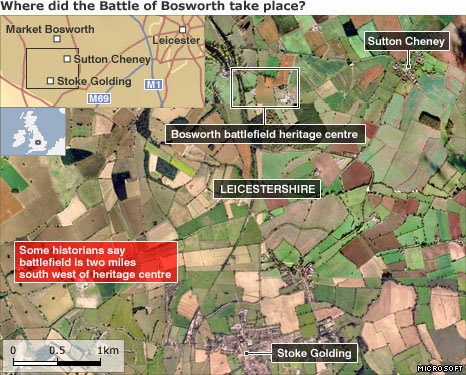
Now a team of historians and archaeologists says it has found the site - and it is not where everyone thought it was.

It is one of Shakespeare's most memorable scenes.

The hunchback Richard III, thrown from his horse and maddened with blood lust, offers up his kingdom in exchange for a replacement steed.

Today the spot where he is supposed to have met his end - a victim of treachery rather than military genius - is marked by a roughly-cut stone memorial in a quiet grove.
The plaque upon it reads simply: "Richard, the last Plantagenet King of England, was slain here 22nd August, 1485."

Except that he was not.

According to a team of battlefield experts and historians the location of the battlefield was two miles to the south and west. At the moment they are being no more precise than that because they fear the activities of illegal treasure seekers.

The investigators have been checking soil samples, analysing peat deposits and carrying out searches with metal detectors. They have also been studying ancient documents and maps for clues.

Using references to places like Redmore (or Reed Moor) and Sandyford (a sandy crossing in the marsh) they have built up a picture of the landscape at the time of the battle.

There have been other clues such as Crown Hill, long thought to have had some connection with the crowning of Henry VII after the battle.

And the study has thrown new light on the use of medieval artillery. They have found 22 lead shots fired by the smallest hand-held gun of the time and from the largest cannon of the time.

All of which presents a problem for the Bosworth Battlefield Heritage Centre which has become popular with tourists, schoolchildren and students. Thousands have attended lectures on the subject and walked for two hours over the battlefield trail.

When the location has been debated before, visitors have expressed mixed feelings.

Many said the precise location of the centre was less important than the quality of educational displays and exhibitions. Others said they would be disappointed not to be able to walk the actual field of battle.

Dr Glen Foard, from the Battlefields Trust, who has led the search, said: "For me the most important thing about the discoveries at Bosworth is that it opens the door for archaeology to explore the origins of firepower.

"In collaboration with the University of Leeds we want to trace this story across Europe."

First Campaign, First Battle 1455

Thomas Stafford, first duke of Buckingham.


Modern historians date the outbreak of the Wars of the Roses to May 1455, when the first pitched battle took place, though, as we have seen, the conflict had been gathering momentum for some time before then.

    Instead of obeying the royal summons, York mobilised his army and began the long march south to London, probably with the intention of intercepting the King before he left for Leicester. With him went his allies, Salisbury, Lord Clinton, Lord Grey of Powys, and Sir Robert Ogle, all with an armed following of their own, Ogle having ‘600 men of the Welsh Marches’. Viscount Bourchier and Lord Cobham may also have been among their number. In the middle of May, Warwick led his army of a thousand men across the heart of England, linking up with York and Salisbury on Ermine Street, the old Roman road. York’s chief objectives were the annihilation of Somerset, the dispersal of the court party, and his own restoration to the Council, which would bring with it control of the King and the government.

    By the 18th, Somerset and the council had been warned that the Yorkists were approaching London with 7000 well-armed men. Benet says: ‘When the Duke of Somerset heard this news he suggested to the King that York had come to usurp the throne. For this reason, the King sided with the Duke of Somerset,’ and authorised him to raise a small army.

    On the 20th York’s company arrived at Royston in Hertfordshire. Here its leaders issued a manifesto declaring to the people that they meant no harm to the King and that they had raised their army and marched south ‘only to keep ourselves out of the danger whereunto our enemies have not ceased to study, labour and compass to bring us’. A copy was sent to the King with a covering letter in which York and his allies begged him not to believe the accusations made against them by their enemies, but again both documents were intercepted, this time by Somerset himself, who destroyed them.

    York was hoping that Norfolk would rally to his support, but although the Duke led a force into Hertfordshire, he made no attempt to join either side, preferring to remain neutral for the present. York had tried on the way south to raise more aristocratic support for his cause, but with little success. His advance at the head of an army looked very much like rebellion, even treason, in view of his public oath that he would never again take up arms against his sovereign.

    While he was still at Royston, York learned that Henry VI and Somerset were about to leave London at the head of an army. On 21 May the Yorkists marched into Ware, where they were told by their scouts that the royal army was advancing north along Watling Street. The Queen was not with them, having taken the Prince of Wales to Greenwich, where she remained during the ensuing hostilities. That same day, York sent a further appeal to the King, along with a copy of his manifesto. Neither got past Somerset.

    Meanwhile, the King and his army had reached Watford, where they spent the night, leaving very early on the morning of the 22nd. York’s scouts advised him that Henry was making for St Albans, and the Duke swung west from Ware to confront him. On the road to St Albans the King received intelligence that Yorkist army was nearing the town. Buckingham urged Henry to press on to St Albans, meet York’s threat head-on, and deal with it firmly, for he was convinced that York would prefer to negotiate a settlement rather than resort to military force. He was also aware that the Yorkist army was larger than the King’s, and believed it would be safer to await reinforcements in the town than in an exposed position in the countryside.

    By 1455 there was little remaining of the original fortifications that had encircled St Albans, just a thirteenth-century ditch, along which wooden barricades could be erected so as to prevent an enemy from entering the market-place. After arriving in St Albans early in the morning of the 22nd, the King commanded his soldiers to occupy the ditch and make it ‘strongly barred and arrayed for defence’, pitching his own camp in the market-place. York, meanwhile, had decided to camp in Key Field, to the east of St Peter’s Street and Holywell Street (now Holywell Hill), and set his men to blocking the exits from the town on that side.

    In 1460, the Milanese ambassador was informed ‘that on that day there were 300,000 men under arms, and indeed the whole of England was stirred, so that some even speak of larger numbers’. This was a gross exaggeration. Benet says that Warwick arrived with 2000 men, York with 3000 and Salisbury with 2000, ‘all well-prepared for battle’. It has been estimated that the royal army numbered 2-3000 men, and may have been short of archers. The Yorkists not only had a strong force of archers but also cannon. Henry had sent an urgent summons to local levies to reinforce his ranks, but they were not ready in time. Only eighteen out of the seventy peers were present at St Albans; thirteen, including Pembroke, were with the King. Others, including Oxford, Shrewsbury, Lord Cromwell and Sir Thomas Stanley, were still on their way.


    The King’s army was under the command of Buckingham, who was hereditary Constable of the realm and had been appointed the King’s Lieutenant for the occasion. Thomas, 8th Lord Clifford, who commanded the Lancastrian vanguard, had earned a distinguished reputation as a veteran of the French wars and for his successes on the Scottish border. The Lancastrian army consisted mainly of knights, members of the King’s household, and the affinities of those few lords who were with him, many of whom came from the eastern counties. Abbot Whethamstead of St Albans, who gives an eyewitness account of these events, states that the East Anglian lords and gentlemen were less warlike than the men of the north in the Yorkist army, ‘for whom wheat and barley’ – which they meant to have as plunder – ‘are like gold and ebony’. The northerners were regarded as foreign savages in the south, and enjoyed a fearsome reputation as ferocious fighters and rapacious looters.

    York’s army was drawn up into three divisions, as was customary, commanded by himself and ‘the captains of the field’, Salisbury and Warwick, the latter having command of the reserve, who were on foot. With York was his thirteen-year-old son, March, who was receiving his first taste of battle, nominally at the head of a small company of seasoned border campaigners. Also with York was Sir John Wenlock, latterly chamberlain to the Queen, who had transferred his loyalty to the Yorkist cause, which he would support for some years to come.

Commencement of The Battle
The commencement of the battle was delayed for three hours, during which York made every effort to induce the King to listen to his complaints about the misgovernment of Somerset and other ‘traitors’. York’s messenger, Mowbray Herald, opened negotiations by entering the town ‘at the barrier’ at the north end of St Peter’s Street, where he was challenged. The herald bore a message from York, suggesting that the King’s army might wish to retreat to Barnet or Hatfield for the night while negotiations proceeded.

    Because his army was the smaller, Henry knew it was to his advantage to negotiate a peaceful settlement, and he sent Buckingham, who was Salisbury’s brother-in-law, to ascertain York’s intentions. York told him that he and his company had come as ‘rightful and true subjects’, who desired only that the King deliver up to them ‘such as we will accuse’. When Buckingham reported these words to Henry, the monarch became uncharacteristically wrathful. Goaded by Somerset, he sent Buckingham back to York with a peremptory message:

    I, King Harry, charge and command that no manner of person abide not, but void the field and not be so hard to make any resistance against me in mine own realm; for I shall know what traitor dare be so bold to raise a people in mine own land, where-through I am in great dis-ease and heaviness. And by the faith that I owe to St Edward and the Crown of England, I shall destroy them, every mother’s son, and they be hanged, drawn and quartered that may be taken afterward, of them to have example to all such traitors to beware to make any such rising of people within my land, and so traitorly to abide their King and Governor. And for a conclusion, rather than they shall have any lord here with me at this time, I shall this day for their sake, and in this quarrel, myself live and die.

    York had failed, thanks in part to the hostility of Buckingham who meant to have him accused before the council at Leicester. The King, in any case, had no intention of delivering Somerset into York’s clutches. Instead, he ordered his standard to be raised in the market-place, had himself clad in plate armour, and mounted his warhorse, positioning it under the fluttering banner. Here he remained for the duration of the battle. Before the fighting commenced, he gave orders that only the lives of the common foot soldiers were to be spared: lords, gentry and yeomen might be put to the sword. Many of the royal soldiers were still hastening back to their positions, having drifted off into the town, seeking refreshment after Buckingham had gone to parley with York.

    York, learning that the King refused to accede to any of his demands, grimly put on his helmet and ordered his trumpeter to sound the alarm which would warn his men that the battle was about to begin. He then made a speech to his troops, using many classical and biblical allusions, saying that he represented Joab, while King Henry was as King David, and together they would overcome Somerset. Thus commenced the Battle of St Albans, the first battle of the Wars of the Roses, some time between ten and twelve in the morning.

York and Salisbury opened the attack from the east, leading charges along St Peter’s Street, Sopwell Street and other streets leading to the market-place, and ordering their men to storm the barricades at the end of them, but Lord Clifford and other Lancastrian commanders ‘strongly kept the barriers’ at every entry. As more Lancastrian troops rallied to the defence, York and Salisbury found themselves being pushed back. Warwick, hearing that their situation was critical, ‘took and gathered his men together and furiously broke in [the town] by the garden sides, between the sign of the Key and the sign of the Checker in Holywell Street’, according to an account in the Stonor Papers. Once in the town, he had his trumpets sounded, and his men responded ‘with a shout and a great voice, “A Warwick! A Warwick!”’ With his progress covered by archers to the rear, Warwick led a fresh assault on the barricades that left his opponents reeling, for they had not expected him to approach from that end of the town.

    ‘The fighting’, says Benet, ‘was furious’, as the market-place became crammed with soldiers locked in a furious combat. As Sir Robert Ogle led his contingent into the mêlée, ‘the alarm bell was rung and every man went to harness’, for many of the King’s troops were ‘out of their array’, not having anticipated that they would be engaged so soon. Within half an hour it was over. As Henry’s men, alerted by the bell sounding in the clock tower in the market-place, raced to defend him, Warwick’s soldiers scythed mercilessly through the Lancastrian ranks until, says Whethamstead – a horrified witness to the carnage – ‘the whole street was full of dead corpses’. The King’s army, ‘disliking the sight of blood’, broke into disarray and withdrew in a stampede, knocking down and trampling underfoot the royal standard as they did so. The Stonor Papers record that the Earl of Wiltshire ‘and many others fled, leaving their harness behind them coward’; Wiltshire, says the chronicler ‘Gregory’, was ‘afraid to lose his beauty’. Many of the King’s party were despoiled of their horses and harness, and the royal banner was retrieved and propped against a house wall, while Henry stood alone and deserted, watching the flight of his men as arrows rained down about him. The Yorkists had won the battle.

    Warwick had specifically instructed his archers to target those about the King – members of the hated court party – and many fell, mortally wounded, near the royal standard. As the battle drew to a close, Henry was wounded in the neck by an arrow and, bleeding profusely, was urged by his remaining nobles to take shelter. As he ran to the nearby house of a tanner, he cried out angrily, ‘Forsooth, ye do foully to smite a king anointed so!’

    Buckingham received wounds to the face and neck and was taken prisoner by the Yorkists. Lord Dudley also got an arrow in the face, and Lord Stafford one in the hand. Henry Beaufort, Earl of Dorset, Somerset’s heir, was so badly hurt that he could not walk and had to be taken home in a cart, as was Wenlock. Benet says that ‘all who were on the side of the Duke of Somerset were killed, wounded, or, at the least, despoiled’.

    Somerset himself had been engaged in desperate hand-to-hand fighting outside an inn called the Castle. Later, it was said that, seeing the sign above him, he was utterly dismayed because he had once been warned by a soothsayer to beware of castles. His opponent – who may even have been Warwick himself – saw him falter, struck home, and killed him. He was later buried in St Albans Abbey, and was succeeded as Duke of Somerset by his son, the nineteen-year-old Earl of Dorset, whom Chastellain describes as ‘a handsome young knight’. A commemorative plaque now marks the site of the Castle Inn, which stood at the corner of St Peter’s Street and what is now Victoria Street.

    Other noble casualties of the battle were Warwick’s great enemy, Henry Percy, 2nd Earl of Northumberland, and Lord Clifford, who were both slain while fighting in the streets. Their bodies were stripped and despoiled, and left naked to public view. Buckingham’s son, Humphrey Stafford, suffered grievous wounds and later died of the effects of them, either in 1455 or 1458. Benet says that ‘about a hundred people were killed, mostly Lancastrian soldiers’. Abbot Whethamstead requested York’s permission to bury the dead, and begged him to show mercy in his hour of victory, as did Julius Caesar. Quoting Ovid, he asked that nothing be sought in addition to victory.

    The outcome of the Battle of St Albans, one of the shortest campaigns of the Wars of the Roses, was that York was able to crush the court faction, which had been deprived of its chief mainstay, Somerset. Much of the blame for the Lancastrian defeat lay with Buckingham, whose judgement and strategies had been fatally flawed. The royal army had faced an almost impossible task in defending all the entrances to the town. They had had little time in which to prepare their defences, and Buckingham had probably made the mistake of relying on some of the buildings to offer a degree of protection.

    York, accompanied by Salisbury and Warwick, now moved to take control of the King’s person, which they found in the tanner’s house having his wound tended. All his earlier bravado had evaporated at the realisation that his army had been defeated. The Stonor Papers record that, when the Yorkist lords came to the King, they fell on their knees ‘and besought him for grace and forgiveness of that they had done in his presence, and besought him, of his highness, to take them as his true liegemen, saying that they never intended hurt to his own person’. Benet says that when Henry heard them declare themselves to be his ‘humble servants, he was greatly cheered’.

    York justified his actions to Henry by pleading that he and his friends had had no alternative but to defend themselves against their enemies. If they had gone to Leicester, as summoned, they would have been taken prisoner and suffered a shameful death as traitors, ‘losing our livelihood and goods, and our heirs shamed for ever’. Henry seemed to accept this and ‘took them to grace, and so desired them to cease their people, and then there should no more harm be done’. Outside in the town, the victorious Yorkist troops were causing havoc. Abbot Whethamstead was shocked to see them rampaging through the streets, looting as they went and leaving behind a trail of destruction. Even in the abbey they stole everything they could lay their hands on, and threatened to burn it down. Then others came, warning them that the King and York, accompanied by the magnates and councillors, had arrived in the market-place and ordered them to reassemble, ready to return to London. Thus the abbey was saved.

    York himself had broken the news of Somerset’s death to the King. Some historians assert that shock, grief, stress and the effects of the wound he had suffered caused Henry to lapse once more into insanity – it was, after all, only five months since his recovery. However, there is no contemporary evidence to support this, and another six months would elapse before York was again appointed Protector. In view of the length of the King’s previous illness, it is likely that the appointment would have taken effect immediately if Henry had displayed symptoms of mental instability. The last word on the subject should be that of John Crane, who wrote to John Paston on 25 May: ‘As for our sovereign lord, thanked be God, he has no great harm.’

  Aftermath
    The fact that a battle had taken place at all shocked many people, even the participants, and provoked the Yorkists into offering extravagant justification of their actions in which they attempted to shift the blame on to Somerset and the court party and thus avoid any suspicion of treason. Nevertheless, the fact remained that they had taken up arms against an army led by their anointed king, and this was enough, in the opinion of many, to condemn them as traitors. To counteract this ill-feeling, York issued a broadsheet giving his account of the battle and the circumstances leading up to it.

    St Albans had accentuated the deep divisions between the magnates and the widespread grievances against the government, which could now, it seemed, only be settled by violence. This realisation acted as a brake for a time upon the warring factions. Neither side had wanted an armed conflict; the King, in particular, and most of his lords were determined that it should not occur again. But the divisions between Lancastrians and Yorkists were now so profound that it would need a committed effort on both sides to preserve the King’s peace. That an uneasy truce prevailed for the next four years is sufficient testimony to the desire of both sides to reach an acceptable settlement.

    On Friday 23 May, York and Salisbury, preceded by Warwick bearing the King’s sword, escorted Henry VI back to London, where he lodged at the bishop’s palace by St Paul’s Cathedral. ‘As for what rule we shall now have, I do not yet know,’ wrote a Paston correspondent. On Sunday the 25th, the Feast of Pentecost, the King went in procession to St Paul’s, wearing his crown, to reassure the people that his royal authority had not been in any way challenged. So potent was the power and mystique of monarchy that still no one ventured to voice the opinion that Henry himself should bear the ultimate responsibility for recent events. There were no calls for his deposition, and no criticisms of his incompetence or poor judgement.

    News of the court party’s defeat and the death of Somerset had soon reached the Queen at Greenwich, causing her deep distress, and the knowledge that York was now to assume the role of chief adviser to the King in Somerset’s place only added to her bitterness. York was immediately appointed Constable of England, an office Somerset had held, and was already filling the late duke’s other offices with men of his own choosing.

    In the week after St Albans, Buckingham, Wiltshire, Shrewsbury, Pembroke and other lords, all back at court, made peace with York and did their best to reconcile the two sides. Jasper Tudor was particularly anxious to devise with York a workable solution to the problems facing the government, and the two men spent many hours in London discussing these.

    But although Somerset was dead, his faction remained. Its members were more hostile than ever towards York, and looked to the Queen, whose influence over a suspicious and resentful Henry VI was paramount, for leadership. York was aware of this, and he knew that some of the King’s household would resist any attempt at reform. He also had to deal with the enmity of individual noblemen, who had good reason to feel bitterness towards him. Lord Clifford’s twenty-year-old son John, now the 9th Lord Clifford, was so incensed against York that he would spend the rest of his life seeking to avenge his father’s death, earning in the process the nicknames ‘Black-faced Clifford’ and ‘Bloody Clifford’.

LINK