Showing posts with label Naval. Show all posts

Monday, March 14, 2016

NAVAL FORCES AS A POLITICAL WEAPON – THE WARS OF THE ROSES


In the absence of royal initiative in England, however, there were others who were willing and able to wield the strength derived from a force of ships to intervene in the increasingly complex struggles between competing factions and claimants to the throne. This is most clearly seen in the case of the Earl of Warwick, but the Duke of Burgundy and the king of France were also prepared to provide naval forces to support their favoured candidate for the English throne.

Richard Neville, Earl of Warwick had been captain of Calais since 1456 and had taken the opportunity afforded by a relatively secure base to build up a squadron of ships. These were used in the manner most likely to advance the fortunes of the Earl himself and the Yorkist cause, which, at that time, he supported. To many English men his naval exploits in the Channel were a welcome sign of ‘enterprise upon the see’. Jack Cade’s proclamation in 1450 at the outset of the Kentish rebellion had bewailed the facts that, ‘the sea is lost, France is lost’. The French raid on Sandwich in August 1457 had been a humiliating reminder of the impotence of English defence. Now John Bale, himself a merchant and a ship-owner, could laud Warwick in his chronicle, praising his ‘greet pollecy and dedes doyng of worship in fortefieng of Cales and other feates of armes’. To modern writers Warwick’s deeds seem at least semi-piratical but to his contemporaries his attack on a Spanish squadron of 28 sail off Calais in early June 1458 and his taking of around 17 prizes out of the Hanse fleet returning with Bay salt later the same summer were victories to savour. It even seems not to have affected his reputation that the first engagement was not entirely successful. John Jernyngham’s letter to Margaret Paston which gives details of the encounter, recounts how he and his crew boarded a large Spanish ship but were unable to hold her. He concludes, ‘and for sooth we were well and truly beat’. The point to contemporaries was that Warwick, who was in fact bound by an indenture of November 1457 to keep the seas, seemed to be acting energetically and speedily even if not all his opponents were clearly ‘the londes adversaries’.

His activities in 1459 and 1460 demonstrate with greater force the way in which the possession of a squadron of ships with experienced crews was greatly to the political advantage of both Warwick personally and the Yorkist cause. After plundering Spanish and Genoese shipping in the Straits in the summer of 1459, Warwick, who had joined the Yorkists in England, seemed to have miscalculated when he was forced to flee from the battle of Ludford Bridge. He reached his base in Calais safely, however, and from that point acted with great skill. Lord Rivers and Sir Gervase Clifton for the king had by December managed to impound Warwick’s ships in Sandwich harbour. The Crown also mustered a small force under William Scott to patrol off Winchelsea to repel any attack by Warwick.

Warwick had many friends in the Southern counties, perhaps beneficiaries of his earlier actions in the Channel. Through them he was well aware of the Crown’s plans. In January a force from Calais commanded by John Dinham, slipped into Sandwich early in the morning, while Rivers was still abed, and persuaded Warwick’s erstwhile shipmasters and crews to return with them to Calais. The royal government attempted to counter this loss by commissioning further forces to serve at sea against Warwick. The Duke of Exeter in May 1460 in fact encountered Warwick’s fleet at some point to the east of Dartmouth and arguably had the opportunity at least to damage very severely the Yorkist cause if not put paid to it entirely. Yet as the Great Chronicle of London put it ‘they fowght not’. Richmond sees this as ‘one of those critical moments when action was essential but was not forthcoming’. In his view Warwick had what the Crown did not, a fleet and a fleet which was used to keep the sea. The use of that fleet was an important factor in the course taken by the domestic politics of England and to Richmond sealed the fate of the Lancastrians.

In 1470, Warwick was personally in a much weaker position. He may still have had some vessels of his own; on his flight from England, after the failure of his intrigues on behalf of the Duke of Clarence, pursued by Lord Howard, he had taken prizes from the Burgundians. He could not, however from his own resources hope to mount an invasion of England to restore his new master Henry VI. He and Queen Margaret were dependent on the aid of Louis XI of France to provide such a fleet. This aid was forthcoming because of the seeming advantage to France in the restoration of the Lancastrians and their adherence to an alliance against Burgundy. Both English and Burgundian naval forces, however, were at sea all summer in an endeavour to keep Warwick’s French fleet in port.

Their efforts seemed successful; by August Warwick’s men were demanding their pay and the people of Barfleur and Valognes had had enough of their presence. A summer gale then dispersed the Yorkist ships at sea and Warwick sailed across unopposed landing on 9 September near Exeter. By the end of the month Edward IV was himself a fugitive restlessly watching the North Sea from his refuge at Bruges with Louis de Gruthuyse, the Burgundian governor of Holland. If he in his turn was to regain his throne his need also was for ships. The Duke of Burgundy was perhaps more discreet in his support for his brother-in-law than Louis XI had been for his cousin, Margaret of Anjou. In March 1471, however, Edward left Flushing with 36 ships and about 2000 men and once ashore at Ravenspur by guile and good luck recovered his Crown.

In the 20 or so years from 1455, therefore, it can be argued that the possession of the potential for naval warfare could be of great advantage to those who wished to be major players in both internal and external politics. No very great or glorious encounters between the vessels of rival powers took place in the Channel or the North Sea. The typical action was that of the commerce raider; a brief violent boarding action ending probably in the surrender of the weaker crew in an attempt to save their skins. Kings and other rulers possessed very few or no ships of their own and were reliant on the general resources of the maritime community. Yet, despite this, the perception of the pressure, which could be exerted by a fleet in being, was more widely appreciated. Warwick has been held up as the individual whose actions demonstrate this most clearly and it is hard to argue against this opinion.

He, perhaps, until the fatal moment on the field at the battle of Barnet, also had luck. Would he have fared well if Exeter had attacked off Dartmouth in 1460? The reasons for Exeter’s loss of nerve are not really clear. Exeter had many warships including the Grace Dieu, built by John Tavener of Hull and formerly Warwick’s own flagship. The Great Chronicle of London speaks vaguely of Exeter’s crews being unwilling to oppose Warwick while the English Chronicle states baldly that Exeter was afraid to fight. Waurin, a Burgundian chronicler, has a circumstantial account of Warwick approaching the coming conflict with great circumspection, sending out fast small vessels ahead of the main fleet to gather intelligence and then calling a council of war of all his ship masters.47 The decision was taken to attack with vigour and maybe the sight of Warwick’s ships coming on at speed with the advantage of the wind terrified Exeter. His lack of courage was certainly a disastrous blow for his party.

On a wider canvas, the situation in these waters as far as the relations between rulers goes has become much more open. In the first third of the century the conflict between England and France was the dominant factor with other states being drawn in as allies of one or the other combatant. After the middle of the century states pursued their own commercial and political interests in a more fluid situation. Naval power was diffuse, not necessarily concentrated in government hands, and the advantage might swing quickly from one state or group of traders to another.

Wednesday, August 12, 2015

Henry Tudor and the Navy


Henry Tudor landing in Wales. After defeating Warwick and regaining the throne Edward began rebuilding the royal fleet by constructing ships and gathering a new cadre of experienced ship's masters. In the 1460s, he had built the first English royal caravel, the Edward, and, after 1471, he constructed fleets to support his invasions of France (1475) and SCOTLAND (early 1480s). 

Although still meant to carry land troops to fight battles at sea, caravels were smaller, faster vessels than Henry V's high, bulky carracks, and they foreshadowed the quick, agile vessels with which Elizabethan England later defied the might of Spain. Despite these achievements, Edward still desired a small, inexpensive navy, and he maintained his fleet largely to protect trade and intercept invaders, a task that RICHARD III's flotilla of watching vessels failed to accomplish in August 1485 when Henry Tudor, earl of Richmond, set sail for WALES. 

After defeating and killing Richard at the Battle of BOSWORTH FIELD, Richmond, now HENRY VII, continued the naval policy of Edward IV, building new ships and establishing a naval base at Southampton. However, he still indented for vessels when he took an army to defend BRITTANY in 1492, and he, like his predecessor, lacked the naval strength to intercept the invasion forces of such Yorkist pretenders as Lambert SIMNEL and Perkin WARBECK, who both had to be defeated in land battles after their arrival in England.

The small navy that Henry VIII inherited from his father had only two sizeable ships, the carracks Regent and Sovereign.

Naval matters were able to open the royal purse. Henry VII began the build up at sea that would characterise the Tudor time. At a cost of £14.000 he let build the Great Harry, England's first warship in the sense that it was the first ship to be built solely for the purpose of fighting at sea. Great Harry was followed by more ships and Henry VII had soon created a respectable navy, earning him the name "the Grandfather of the Royal Navy". Henry's days also saw the first English explorers. Henry turned down an offer from Christopher Columbus's brother Bartholomeus to finance a journey westwards. Later John Cabot won the Kings ear and explored Newfoundland, thus becoming the first European to set his foot on the American mainland.

Henry VII
By late summer 1483, Richard III's usurpation of the English Crown and the growing belief that he had murdered his nephews made Richmond a more attractive candidate for the throne (see USURPATION OF 1483). While Richmond's mother plotted with Queen Elizabeth WOODVILLE to put the earl on the throne and marry him to ELIZABETH OF YORK, daughter of Edward IV, Henry STAFFORD, duke of Buckingham, deserted Richard and hatched his own plot. In the autumn, the two conspiracies merged into BUCKINGHAM'S REBELLION, an unsuccessful uprising that Richmond himself supported with an abortive descent on the English coast. Although Richard's soldiers tried to draw the earl ashore by posing as friends, Richmond learned of Buckingham's failure and returned safely to Brittany. In 1484, as a growing body of English exiles collected around him, Richmond fled into France, foiling a plot by Pierre Landais to turn him over to Richard's agents.
With French assistance, Richmond and his uncle landed in Wales in August 1485. Leading a force of over 2,000 French and Scottish mercenaries and some 600 English supporters, Richmond crossed Wales and entered England, collecting support along the way from both old Lancastrians and disaffected Yorkists. However, his army was still smaller than the king's when he met Richard in battle near the village of Market Bosworth on 22 August. Defeated by disloyalty in his ranks and by the intervention on Richmond's side of Sir William STANLEY, brother of Thomas STANLEY, Lord Stanley (Richmond's stepfather), Richard was killed on the field, and Richmond was proclaimed king as Henry VII. 

As heir of Lancaster, Henry sought to symbolically end the WARS OF THE ROSES by marrying Elizabeth, the heiress of York, in January 1486. Nonetheless, Henry spent much of his reign combating Yorkist attempts to regain the throne. In June 1487, he defeated the partisans of Lambert SIMNEL at the Battle of STOKE. Simnel claimed to be Edward PLANTAGENET, earl of Warwick, the nephew of Edward IV and the last Yorkist claimant in the direct male line. A prisoner in the TOWER OF LONDON since 1485, Warwick was executed in 1499 after being implicated in an escape plot with Perkin WARBECK, another Yorkist pretender who had troubled Henry throughout the 1490s by claiming to be Richard PLANTAGENET, duke of York, the younger son of Edward IV, who had probably died in the Tower with his brother EDWARD V in 1483. Despite these and other Yorkist threats to his dynasty, Henry VII, at his death on 21 April 1509, peacefully passed a stable and strengthened Crown to his son Henry VIII.

Wednesday, March 18, 2015

NAVAL FORCES AS A POLITICAL WEAPON – THE WARS OF THE ROSES

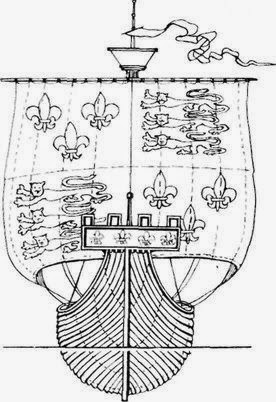
A ship from Richard III's reign.

In the absence of royal initiative in England, however, there were others who were willing and able to wield the strength derived from a force of ships to intervene in the increasingly complex struggles between competing factions and claimants to the throne. This is most clearly seen in the case of the Earl of Warwick, but the Duke of Burgundy and the king of France were also prepared to provide naval forces to support their favoured candidate for the English throne. Richard Neville, Earl of Warwick had been captain of Calais since 1456 and had taken the opportunity afforded by a relatively secure base to build up a squadron of ships. These were used in the manner most likely to advance the fortunes of the Earl himself and the Yorkist cause, which, at that time, he supported. To many English men his naval exploits in the Channel were a welcome sign of 'enterprise upon the see'. Jack Cade's proclamation in 1450 at the outset of the Kentish rebellion had bewailed the facts that, 'the sea is lost, France is lost'. The French raid on Sandwich in August 1457 had been a humiliating reminder of the impotence of English defence. Now John Bale, himself a merchant and a ship-owner, could laud Warwick in his chronicle, praising his 'greet pollecy and dedes doyng of worship in fortefieng of Cales and other feates of armes'. To modern writers Warwick's deeds seem at least semi-piratical but to his contemporaries his attack on a Spanish squadron of 28 sail off Calais in early June 1458 and his taking of around 17 prizes out of the Hanse fleet returning with Bay salt later the same summer were victories to savour. It even seems not to have affected his reputation that the first engagement was not entirely successful. John Jernyngham's letter to Margaret Paston which gives details of the encounter, recounts how he and his crew boarded a large Spanish ship but were unable to hold her. He concludes, 'and for sooth we were well and truly beat'. The point to contemporaries was that Warwick, who was in fact bound by an indenture of November 1457 to keep the seas, seemed to be acting energetically and speedily even if not all his opponents were clearly 'the londes adversaries'.

His activities in 1459 and 1460 demonstrate with greater force the way in which the possession of a squadron of ships with experienced crews was greatly to the political advantage of both Warwick personally and the Yorkist cause. After plundering Spanish and Genoese shipping in the Straits in the summer of 1459, Warwick, who had joined the Yorkists in England, seemed to have miscalculated when he was forced to flee from the battle of Ludford Bridge. He reached his base in Calais safely, however, and from that point acted with great skill. Lord Rivers and Sir Gervase Clifton for the king had by December managed to impound Warwick's ships in Sandwich harbour. The Crown also mustered a small force under William Scott to patrol off Winchelsea to repel any attack by Warwick. Warwick had many friends in the Southern counties, perhaps beneficiaries of his earlier actions in the Channel. Through them he was well aware of the Crown's plans. In January a force from Calais commanded by John Dinham, slipped into Sandwich early in the morning, while Rivers was still abed, and persuaded Warwick's erstwhile shipmasters and crews to return with them to Calais. The royal government attempted to counter this loss by commissioning further forces to serve at sea against Warwick. The Duke of Exeter in May 1460 in fact encountered Warwick's fleet at some point to the east of Dartmouth and arguably had the opportunity at least to damage very severely the Yorkist cause if not put paid to it entirely. Yet as the Great Chronicle of London put it 'they fowght not'. Richmond sees this as 'one of those critical moments when action was essential but was not forthcoming'. In his view Warwick had what the Crown did not, a fleet and a fleet which was used to keep the sea. The use of that fleet was an important factor in the course taken by the domestic politics of England and to Richmond sealed the fate of the Lancastrians.

In 1470, Warwick was personally in a much weaker position. He may still have had some vessels of his own; on his flight from England, after the failure of his intrigues on behalf of the Duke of Clarence, pursued by Lord Howard, he had taken prizes from the Burgundians. He could not, however from his own resources hope to mount an invasion of England to restore his new master Henry VI. He and Queen Margaret were dependent on the aid of Louis XI of France to provide such a fleet. This aid was forthcoming because of the seeming advantage to France in the restoration of the Lancastrians and their adherence to an alliance against Burgundy. Both English and Burgundian naval forces, however, were at sea all summer in an endeavour to keep Warwick's French fleet in port. Their efforts seemed successful; by August Warwick's men were demanding their pay and the people of Barfleur and Valognes had had enough of their presence. A summer gale then dispersed the Yorkist ships at sea and Warwick sailed across unopposed landing on 9 September near Exeter. By the end of the month Edward IV was himself a fugitive restlessly watching the North Sea from his refuge at Bruges with Louis de Gruthuyse, the Burgundian governor of Holland. If he in his turn was to regain his throne his need also was for ships. The Duke of Burgundy was perhaps more discreet in his support for his brother-in-law than Louis XI had been for his cousin, Margaret of Anjou. In March 1471, however, Edward left Flushing with 36 ships and about 2000 men and once ashore at Ravenspur by guile and good luck recovered his Crown.

In the 20 or so years from 1455, therefore, it can be argued that the possession of the potential for naval warfare could be of great advantage to those who wished to be major players in both internal and external politics. No very great or glorious encounters between the vessels of rival powers took place in the Channel or the North Sea. The typical action was that of the commerce raider; a brief violent boarding action ending probably in the surrender of the weaker crew in an attempt to save their skins. Kings and other rulers possessed very few or no ships of their own and were reliant on the general resources of the maritime community. Yet, despite this, the perception of the pressure, which could be exerted by a fleet in being, was more widely appreciated. Warwick has been held up as the individual whose actions demonstrate this most clearly and it is hard to argue against this opinion. He, perhaps, until the fatal moment on the field at the battle of Barnet, also had luck. Would he have fared well if Exeter had attacked off Dartmouth in 1460? The reasons for Exeter's loss of nerve are not really clear. Exeter had many warships including the Grace Dieu, built by John Tavener of Hull and formerly Warwick's own flagship. The Great Chronicle of London speaks vaguely of Exeter's crews being unwilling to oppose Warwick while the English Chronicle states baldly that Exeter was afraid to fight. Waurin, a Burgundian chronicler, has a circumstantial account of Warwick approaching the coming conflict with great circumspection, sending out fast small vessels ahead of the main fleet to gather intelligence and then calling a council of war of all his ship masters.47 The decision was taken to attack with vigour and maybe the sight of Warwick's ships coming on at speed with the advantage of the wind terrified Exeter. His lack of courage was certainly a disastrous blow for his party.

On a wider canvas, the situation in these waters as far as the relations between rulers goes has become much more open. In the first third of the century the conflict between England and France was the dominant factor with other states being drawn in as allies of one or the other combatant. After the middle of the century states pursued their own commercial and political interests in a more fluid situation. Naval power was diffuse, not necessarily concentrated in government hands, and the advantage might swing quickly from one state or group of traders to another.

Book: Medieval Ships and Warfare

Edited by Susan Rose, Open University, UK
The International Library of Essays on Military History
This collection of essays and articles from a wide range of journals is intended to make more accessible to students and scholars some of the most important writing in English in this field from the 1950s to the present day. The volume draws attention to work on both the design and the use of ships in warfare in the period c.1000-c.1500. The collection deals with both the Mediterranean and northern waters in this period and not only makes clear what work has been done in this field but indicates areas where more research is needed.


Contents Series preface; Introduction; Part I North Western Europe: Ships and Boats: Issues of Technology and Evidence: Documentary sources and the medieval ship: some aspects of the evidence, Ian Friel; English galleys 1272-1377, J.T. Tinniswood; The building of the Lyme galley, 1294-1296, Ian Friel; Bayonne and the king's ships, 1204-1420, Susan Rose. Piracy and Pirates: John Crabbe: Flemish pirate, merchant and adventurer, Henry S. Lucas; Henry IV and the English privateers, Stephen P. Pistono; Piracy or policy: the crisis in the Channel, 1400-1403, C.J. Ford. Fleets and Warfare: The Battle of Damme - 1213, F.W. Brooks; God, leadership, Flemings and archery: contemporary perceptions of victory and defeat at the Battle of Sluys, 1340, Kelly De Vries; The effects of the Battle of Sluys upon the administration of English naval impressment, 1340-1343, J.S. Kepler; The naval service of the Cinque Ports, N.A.M. Rodger; The Earl of Warwick's domination of the Channel and the naval dimension of the Wars of the Roses, 1456-1460, Colin Richmond. Part II The Mediterranean: Islam versus Christendom: the naval dimension, 1000-1600, Susan Rose. The Islamic Powers: The Fatimid navy during the early crusades, 1099-1124, William Hamblin; The Mamluks and naval power: a phase of the struggle between Islam and Christian Europe, David Ayalon; The place of Saladin in the naval history of the Mediterranean sea in the middle ages, A.S. Ehrenkreutz; Piracy as an Islamic-Christian interface in the 13th century, Robert I. Burns; Rotting ships and razed harbors: the naval policy of the Mamluks, Albrecht Fuess. Iberia: The naval battles of Roger of Lauria, John H. Pryor; The Catalan fleet and Moorish sea-power (1337-1344), J.A Robson; Ships of the 13th-century Catalan navy, Lawrence V. Mott; The warships of the kings of Aragon and their fighting tactics during the 13th and 14th centuries AD, Frederico Foerster Laures; Reportage representation and reality: the extent to which chronicle accounts and contemporary illustrations can be relied upon when discussing the tactics used in medieval galley warfare, Susan Rose; The lexicon of naval tactics in Ramon Muntaner's Crònica, William Sayers. Genoa and Venice: Naval strategy in the first Genoese-Venetian war, 1257-1270, John E. Dotson; Fleet operations in the first Genoese- Venetian War, 1264-66, John E. Dotson; Foundations of Venetian naval strategy from Pietro II Orseolo to the Battle of Zonchio, 1000-1500, John E. Dotson; Name index.
 
About the Editor Susan Rose is from the Department of History at the Open University, UK.
www.ashgate.com/isbn/9780754624851 ASHGATE

ENGLISH NAVY

Longbowmen and crossbowmen take aim at one another in this depiction of a fifteenth-century naval battle.


During the WARS OF THE ROSES, England had no standing fleet, and naval needs were met by indenting (contracting) with merchants and nobles to supply ships and crews to perform a specified service for a specified time. Not meant for voyaging in the open sea, civil war naval forces operated mainly in the Narrow Seas (i.e., the English Channel), where they undertook to intercept invaders, ward off coastal raiders, transport English armies, protect English traders, and maintain communication and supply lines with CALAIS.

After Henry V's death in 1422, the powerful but expensive fleet that he had built to support military operations in FRANCE was disbanded. Because Henry's conquest of the Norman coast denied the French access to Channel ports, the need for a large English navy seemed to disappear, and the minority government of HENRY VI sold off ships and discharged experienced ship's masters. By the late 1450s, with Normandy lost and civil war looming, Henry VI had no fleet and no money to build one. As a result, control of the Channel fell to the house of YORK after 1456, thanks mainly to the piratical activities of Richard NEVILLE, earl of Warwick. As captain of Calais, Warwick appropriated wool revenues to build a fleet that plundered merchant vessels of various nationalities. 

While Warwick's piracy embroiled the Lancastrian government with outraged foreign powers, it won the earl and the Yorkist cause much popularity, especially in LONDON, where Warwick was seen as a bold commander striking a much needed blow for English national pride. Warwick's naval success was also a PROPAGANDA windfall for the Yorkists, because it could be profitably contrasted with Lancastrian ineffectiveness, especially in August 1457 when the government failed to prevent a French squadron under Pierre de BRÉZÉ from sacking Sandwich. In 1460, Warwick defeated the royal fleet under Henry HOLLAND, duke of Exeter, and also attacked Sandwich, where he destroyed a squadron then under construction and captured the Lancastrian commander, Richard WOODVILLE, Lord Rivers, in his bed. Unopposed in the Channel, Warwick crossed to England in June; his popularity as a naval commander convinced London authorities to admit the Yorkists and allowed Warwick to gather the army with which he defeated and captured the king at the Battle of NORTHAMPTON in July.

In the spring of 1470, after the failure of his second coup attempt against EDWARD IV, Warwick put to sea in the naval squadron he had maintained during the 1460s. Denied entry to Calais, Warwick resumed indiscriminate piracy in the Channel before landing in France, where he concluded the ANGERS AGREEMENT with Queen MARGARET OF ANJOU. Now acting in the Lancastrian interest, Warwick eluded the small royal fleet and landed in England, where in October he restored the house of LANCASTER and forced Edward IV to flee to BURGUNDY. However, Edward, thanks in part to anger generated by Warwick's piracy, was by March 1471 able to obtain shipping to England from the HANSEATIC LEAGUE, a German merchant alliance with which his government had previously been at war.

After defeating Warwick and regaining the throne, Edward began rebuilding the royal fleet by constructing ships and gathering a new cadre of experienced ship's masters. In the 1460s, he had built the first English royal caravel, the Edward, and, after 1471, he constructed fleets to support his invasions of France (1475) and SCOTLAND (early 1480s). Although still meant to carry land troops to fight battles at sea, caravels were smaller, faster vessels than Henry V's high, bulky carracks, and they foreshadowed the quick, agile vessels with which Elizabethan England later defied the might of Spain. Despite these achievements, Edward still desired a small, inexpensive navy, and he maintained his fleet largely to protect trade and intercept invaders, a task that RICHARD III's flotilla of watching vessels failed to accomplish in August 1485 when Henry Tudor, earl of Richmond, set sail for WALES. After defeating and killing Richard at the Battle of BOSWORTH FIELD, Richmond, now HENRY VII, continued the naval policy of Edward IV, building new ships and establishing a naval base at Southampton. However, he still indented for vessels when he took an army to defend BRITTANY in 1492, and he, like his predecessor, lacked the naval strength to intercept the invasion forces of such Yorkist pretenders as Lambert SIMNEL and Perkin WARBECK, who both had to be defeated in land battles after their arrival in England.

Further Reading: Rodger, N.A. M., The Safeguard of the Sea:A Naval History of Britain (New York: W.W. Norton, 1998).

PIERRE DE BRÉZÉ, SENESCHAL OF NORMANDY (C. 1408–1465)

A friend of Queen MARGARET OF ANJOU, Pierre de Brézé, seneschal of Normandy, fought for the Lancastrians in the northern campaigns of the early 1460s.

A vassal of Margaret's father, de Brézé became one of the chief ministers and military commanders of CHARLES VII, and took part in the negotiations that led to Margaret's marriage to HENRYVI in 1445. The queen's connections with de Brézé led to rumors that Margaret had instigated the seneschal's raid on Sandwich in August 1457 to help her win her power struggle with Richard PLANTAGENET, duke of York. This charge has been dismissed by modern historians, but Margaret did appeal to de Brézé for French naval assistance in 1460 to prevent York's ally, Richard NEVILLE, earl of Warwick, from returning to England from his base at CALAIS. After the Lancastrian defeat at the Battle of TOWTON in March 1461, Charles VII allowed de Brézé, who had been advocating French support for the house of LANCASTER since 1459, to assemble a fleet and attack the English Channel Islands.

De Brézé seized Jersey in May, but the death of Charles VII in July ended the Seneschal's efforts on Margaret's behalf, for LOUIS XI, the new French king, stripped de Brézé of his offices and imprisoned him in Loches Castle. Never on good terms with his father, Louis distrusted de Brézé for his past loyalty to Charles. In April 1462, Margaret secured de Brézé's release as part of the Franco-Lancastrian CHINON AGREEMENT, whereby Louis lent money to the queen in return for her surrender of Calais. Although Louis's enthusiasm for the alliance faded when the Burgundians denied him access to Calais, he allowed de Brézé to accompany Margaret and her son Prince EDWARD OF LANCASTER to SCOTLAND in October. Commanding 800 French troops in his own pay, the seneschal and the Lancastrian royal family landed near BAMBURGH CASTLE in Northumberland on 25 October. Although Bamburgh and the neighboring castles of ALNWICK and DUNSTANBURGH quickly submitted to Henry VI, Margaret and de Brézé, believing themselves too weak to face the army EDWARD IV was bringing against them, retreated to Scotland in November. The royal family and de Brézé arrived safely in BERWICK only after a local fisherman rescued them from their foundering vessel. De Brézé's troops were less fortunate, being forced ashore on Lindisfarne, where most were killed or captured by the local inhabitants.

In January 1463, de Brézé and the Scottish earl of Angus led a mainly Scots force that surprised Warwick as he besieged the Lancastrian garrison in Alnwick Castle. Perhaps unwilling to give battle because of the low morale of his troops, Warwick allowed the garrison to withdraw into Scotland with de Brézé's army. In June, de Brézé returned to England as part of a Scottish invasion force that included not only Henry VI and Queen Margaret, but also JAMES III of Scotland and his mother MARY OF GUELDRES. The invaders besieged Norham Castle until surprised by a Yorkist force under Warwick and his brother John NEVILLE, Lord Montagu. The Scots army disintegrated in panic, and de Brézé, Margaret, and Prince Edward escaped to Berwick, while Henry VI fled into Scotland. In early August, de Brézé accompanied Margaret and the prince to FRANCE. Restored to his offices in 1464, de Brézé was killed while leading Louis XI's forces against the Burgundians at the Battle of Montlhéry in July 1465.

Further Reading: Haigh, Philip A., The Military Campaigns of the Wars of the Roses (Stroud, Gloucestershire, UK: Sutton Publishing, 1995); Kendall, Paul Murray, Louis XI (New York:W.W. Norton, 1971);Vale,M.G.A., Charles VII (Berkeley: University of California Press, 1974).